Friday, July 17, 2026
Automating the finishing process: the new challenge for publishing houses
2026Visual CommunicationCutting and finishing

Why can automating the final cut transform publishing production?
EMG, exhibitor at the next edition of C!Print Madrid, which will be held from January 12 to 14, 2027 explains us why the automation of three-sided cutting allows for reduced time, minimized handling, and improved productivity in a market where short runs and on-demand printing dictate the pace of production.
Printing and bookbinding have evolved considerably in recent years. However, in many printing shops, the final cutting of books is still carried out using processes that require multiple manipulations and significant operator intervention.
In an environment where orders are increasingly varied, format changes are more frequent, and delivery times are tighter, this last phase can end up conditioning the productivity of the entire finishing line.
More and more printing companies are analyzing their entire production flow and finding that optimizing only printing or binding is no longer enough. Efficiency depends on all stages working at the same pace, including final cutting.
The finishing process is also part of the automation.
Traditionally, three-knife trimming has been a manual operation that requires repositioning each book several times before achieving the final finish. Although it is the last step in the process, its impact on productivity, repeatability, and delivery times is considerable.
Automating this operation reduces handling, minimizes errors, and maintains consistent quality across all units. Furthermore, it decreases operator dependence and facilitates the production of increasingly varied jobs without compromising setup times.
This evolution is especially relevant in a market where on-demand production and short runs require continuous format changes and greater flexibility.
Challenge responds to a growing need in the sector
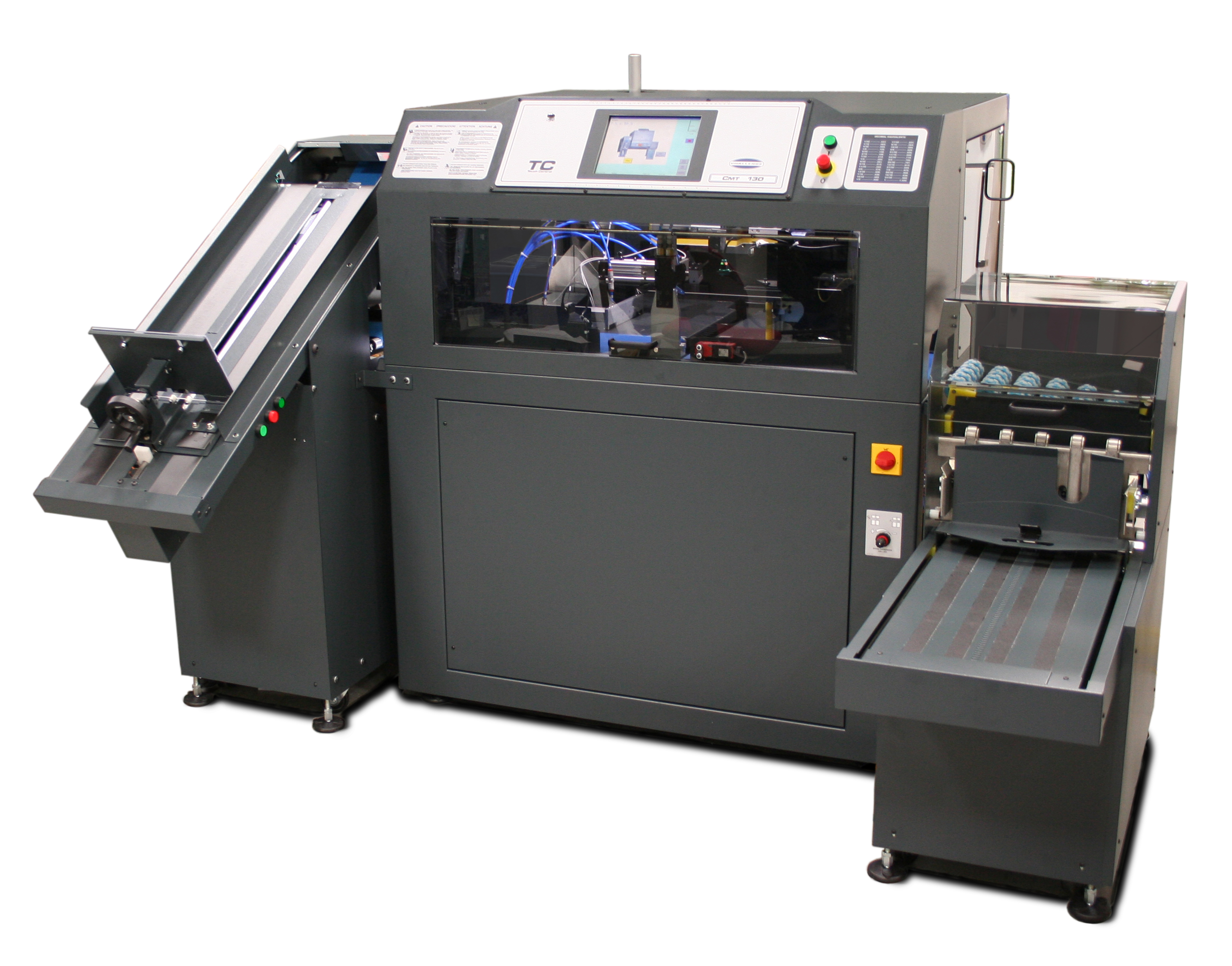
To respond to this scenario, Challenge has developed the trilateral guillotines. CMT-130TC and CMT-330TC, two solutions designed to automate the final cutting of paperback books.
The CMT-130TC It is geared towards on-demand production environments and short or medium print runs, allowing format changes in less than ten seconds and achieving production rates of up to 500 books per hour.
For its part, the CMT-330TC It expands production capacity for centers with higher work volumes, offering format changes in less than six seconds and a throughput of up to 750 books per hour.
Both machines incorporate automation in a phase that has traditionally required a high degree of manual intervention, allowing for a precise, homogeneous, and repeatable finish in a wide variety of formats.