Thursday, September 17, 2026
The point of sale no longer sells: it tells stories, connects, and demands consistency

Two C!Print Madrid conferences, one diagnosis: physical retail risks its brand narrative and the credibility of its materials in the same square meter
For years, the physical store was where the transaction happened. Today, it's also where the brand happens. Two of the conferences C!Print Madrid one about the new language of the point of sale and another one about Sustainability in visual communication in retail. They agreed on the same diagnosis from different angles: the commercial space has become an emotional and social space, and that forces us to rethink both what is told and what is built with.
From selling products to designing long-term sustainability
At the table The new language of the Point of Sale: Strategy, branding and trade, Juan Carlos Martín, Director of PLV IMPACT; Juan Mellen, CEO and President of the Design Institute of Spain (DiOS); and Jaime Dolagaray, Managing Partner of BRANWARD and Vice President of AEBRAND. They described a retail sector that no longer competes solely for sales, but also for time, experience, and memory.
He Today, retail design combines architecture, interior design, branding, graphic design, and consumer psychology.r. Lighting has ceased to serve solely to showcase the product and now also guides the customer's path towards key areas. POS incorporates screens, augmented reality, and QR codes. This is another way to provide information and interaction. And trade marketing has become "integrated": it no longer applies isolated tactics but orchestrates a complete experience.
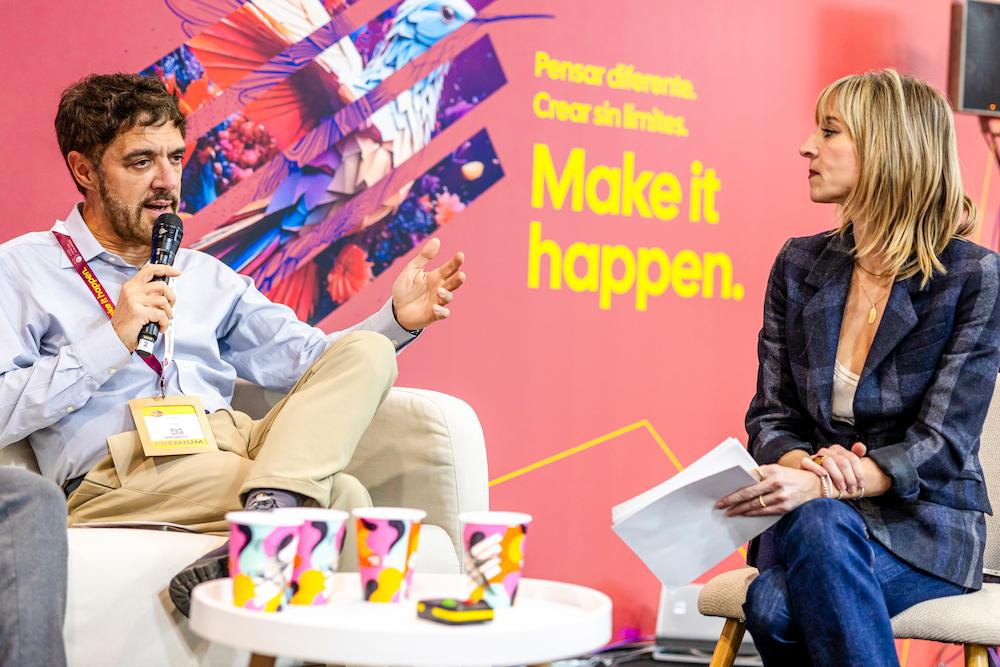 Juan Mellen, director of the Design Institute of Spain, and Rebeca Marín, journalist, during the conference The new language of the Point of Sale: Strategy, branding and trade.
The blind spot: consistency and forgotten ambassadors
But the story has a blind spot, differentiation, as was argued in court, It's no longer so much about positioning oneself in one way or another, but about achieving consistency between what a brand says and what it does.Two mistakes are repeated: chasing trends that have nothing to do with the brand's DNA and pursuing new audiences while neglecting existing ones. Furthermore, there's a third, more silent factor: the employee. Months are invested in defining tone of voice, sensory identity, and storytelling, and then the brand's primary ambassador—the person in daily contact with the customer—is sidelined.
There were examples with names and surnames, from a flagship store in Barcelona with design obstacles that the staff themselves overcame daily, to the cafeteria that Zara integrated into a store in Madrid to prolong the stay, which is worth listening to directly in the video that accompanies this article.
"There are no sustainable materials, there are sustainable processes."
The other conference, Sustainability in visual communication in retailHe dismantled, with the same frankness, one of the most overused words in the sector. Nicolás Coupry, Visual Communication Sustainability Lead at ANTALIS; Mario Ramón, retailer at SERVEI ESTACIÓ; and Lisardo Mendo, Visual Merchandiser and professor at ESDESIGN and BCN RETAIL SCHOOLThey focused on a much more uncomfortable issue: a material, by itself, does not determine whether a solution is sustainable.
Mario Ramón put it bluntly: what matters are the processes and the uses. We must Evaluate the material based on its application, durability, reusability, and what happens at the end of its useful life..
From that perspective, cardboard ceases to be automatically virtuous, while materials such as aluminum —which can be recycled repeatedly— or certain long-lasting supports can have a different environmental behavior depending on the specific application.
The warning to creatives was stark: when sustainability is understood solely as an aesthetic of green and wood, it can end up limiting innovation instead of driving it.
The session was moderated by Maria Callis, specialist in Retail Strategy & Design and president of the Retail Design Institute (RDI).
One ton of PVC per month and 80% decided in the design
Lisardo Mendo pointed out that shop window and store interior cycles can last only three or four weeks: each campaign thus generates a volume of waste that is difficult to ignore. A study conducted by us on Barcelona's flagship sports stores estimated that one ton of PVC is removed monthly after 15 to 30 days of use.By tracing the municipal recovery protocol, they also discovered that the PVC ended up mixed with the rest of the plastics..
From the distribution perspective, Nicolás Coupry highlighted the scale of the problem and, at the same time, the room for maneuver: visual communication represents approximately 1% of global plastic consumption, and, according to data shared during the conference, around 80% of its impact is determined during the design phase, when choosing which material to use, for what application, and for how long. This has led to the development of tools such as the zero-to-five-star rating matrix, training initiatives for printers, and viable alternatives, such as 100% aluminum honeycomb panels as an alternative to Dibond-type composite materials, which are difficult to separate.
The conclusion can be summed up in one word: criteria
Both tables end at the same point. Advocating criteria for deciding which narrative a brand supports within its storeCriteria for choosing why a material is there, how long it will be used, how many times it can be assembled and disassembled, and what will happen to it when the campaign ends. Because The future of the point of sale is not decided solely in the marketing departmentIt's also decided in the design, the production, the materials, and everything that happens after the campaign ends. The rest is greenwashing with good typography.
You can watch both conferences in full in the videos below, with more examples and more data:
If you want to learn more about the trends in retail, and in person, C!Print Madrid returns from January 12th to 14th, 2027: three days to touch the materials, discuss with those who manufacture them and discover new applications and solutions for retail and visual communication.